

Clink Launches the World's First Fiat Agentic Payment Skill, Letting Any Merchant Get Paid by AI Agents
A new category of payment infrastructure: agentic in capability, harnessed by design. ModelMax and PollyReach are the first Clink-enabled merchants. Public access is now open to AI builders and digital merchants worldwide.
SAN FRANCISCO, California, April 30, 2026 (GLOBE NEWSWIRE) -- Clink, the AI-native payments infrastructure, today launched the world's first fiat Agentic Payment Skill, a production-ready capability that lets autonomous AI agents pay for products and services in real currencies, on the user's existing credit card, under user-defined limits—a harnessed model by design.
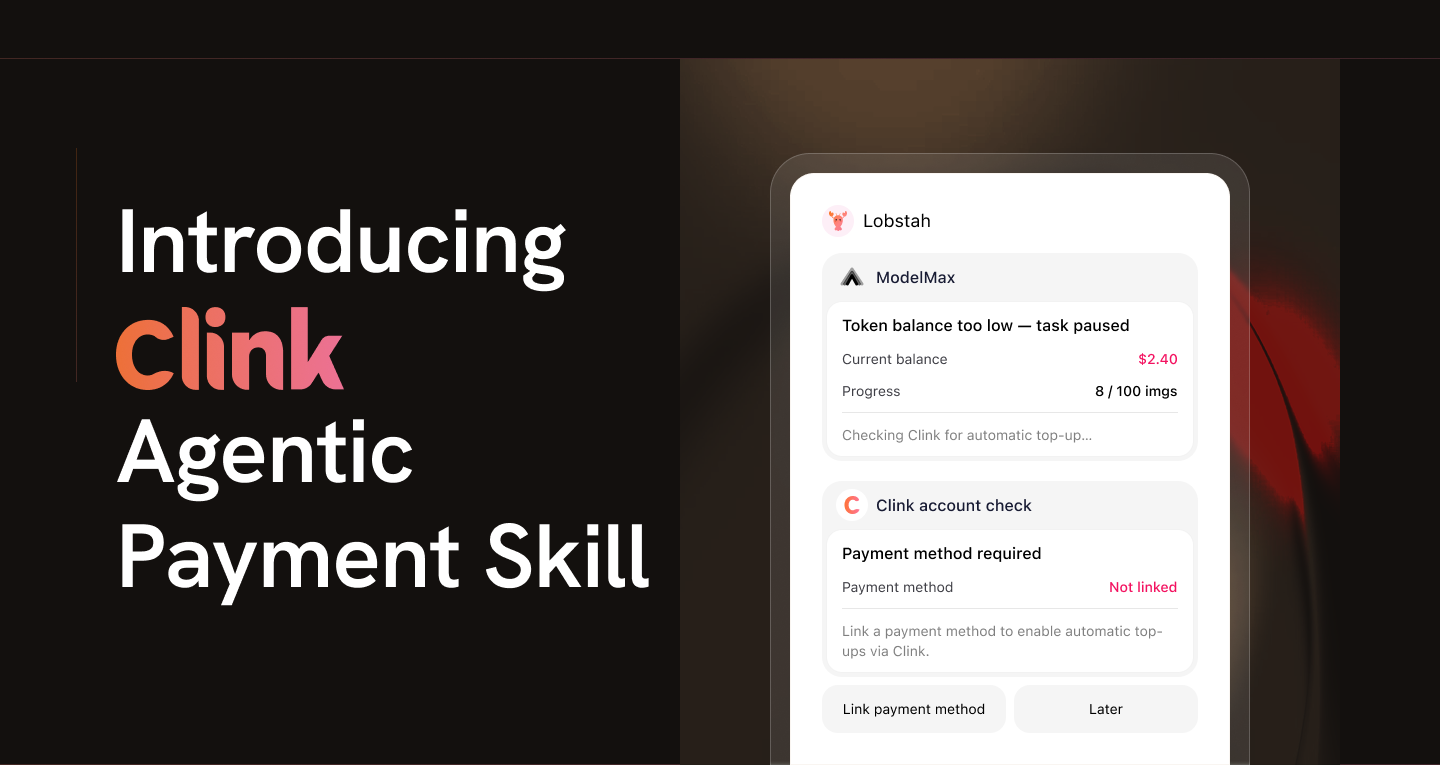
Two early Clink-enabled merchants are live today: ModelMax, the unified LLM gateway providing a single API to OpenAI, Anthropic, Google, and 20+ other foundation models; and PollyReach, an AI calling product that gives every agent its own phone number. Both products can now be paid for by agents directly, opening up a category of revenue most digital products have never tapped.
These first integrations are AI products, but Clink is designed to extend wherever agents need to spend: stock photo libraries, data APIs, SaaS tools, content platforms, and over time, physical commerce, anywhere a digital instruction can settle a real transaction.
Three principles behind Harness Payment
Clink’s Agentic Payment Skill is built on three core principles:
- No new wallets and no new payment systems. Agents pay in fiat using the same cards and local payment methods users already trust. Clink supports 135+ currencies and 100+ local payment methods, including Apple Pay, Google Pay, PayPal, PIX, iDEAL, Alipay, WeChat Pay, and KakaoPay.
- No exposure of raw payment data to agents. Funding sources are stored using PCI-compliant infrastructure at the same security level as enterprise payment processors, with tokenization applied by default.
- No uncontrolled spending. Users define how much an agent can spend, how often it can spend, and under what conditions. These limits are enforced at the infrastructure layer, not delegated to agent behavior.
How it works for merchants
Clink ships an integration skill that turns merchant onboarding itself into an agent task. Coding agents like Claude Code or Cursor can run it end-to-end: product and pricing configuration, API wiring, test transactions. Integration is no longer a sprint. It's a prompt.
Once integrated, Clink-enabled merchants get:
- Payments from any authorized agent, settled in fiat, on real cards, through the same payment processors digital products already work with.
- Per task, per call, per token revenue, not just per subscription. Agents pay for exactly what they use. Subscriptions still work for human users; Clink adds a per-use revenue layer on top, sized to how agents actually consume.
- User-side spending control, automatically enforced. Each agent operates within spending limits its user has pre-set: daily budget, top-up frequency, risk rules. Clink enforces these at the infrastructure layer, so merchants don't have to design their own authorization logic.
60 seconds: see an agent pay for API credits, hands-free.
ModelMax was a natural first integration. Agents using its LLM gateway burn through tokens continuously, and a workflow that breaks when the balance hits zero is the worst possible user experience. With Clink, agents on ModelMax now top themselves up automatically the moment they're projected to run low, within seconds, within the user's pre-authorized budget, with no human interruption.
PollyReach shows a different pattern: products being redesigned to be called by other agents. Its calling capability used to live behind a website with a login and a monthly subscription. Now it sits in the cloud as a Clink-enabled service that any compliant agent can invoke and pay for, on a true per-call basis. One agent calls another. The transaction settles. The user isn't pulled back in mid-task.
"Agent demand is uncapped. The question is whether your product can capture it."
"For the past 20 years, products competed for human attention. Now they compete for agent spend," said Patrick Wu, CEO and Founder of Clink. "Human attention is limited. Agent demand is not. The first group of merchants that can accept payments from agents will define the next generation of digital business models."
He added: "We built Clink so merchants don't need to design their own payment, vault, and authorization layers to get there. Agentic payment only works if it's Harness Payment—agents need the power to transact, never the freedom to drift. The shortcut would have been to issue a token and route around traditional payments. But you can't build a real harness on a parallel system. PCI compliance, fiat settlement, real cards, global coverage are the hard parts, and they're what makes the harness real. Payment is fundamentally about trust. If a user can't use their existing card, it can't become infrastructure."
Public access is now open
Clink's foundation has been built over the past year, including PCI certification in mid-2025 and first commercial transactions in late 2025. The Agentic Payment Skill released today is built on top of that infrastructure.
Clink is now open to merchants worldwide. Companies interested in becoming Clink-enabled and capturing payment volume from agents can get started at clinkbill.com.
About Clink
Clink is an AI-native payments infrastructure for the agent economy. Backed by Celtic and Baidu Ventures, it provides billing, authorization, and risk control systems that allow autonomous AI agents to pay for products and services in fiat across 135+ currencies and 100+ local payment methods. Clink supports subscription billing, taxation, and compliance, enabling reliable and secure agent-initiated payments.
For merchant onboarding: clinkbill.com
For media and partnership inquiries: contact@clinkbill.com
For Clink updates: linkedin.com/company/clinkbill

Julie Wang
julie@clinkbill.com

Legal Disclaimer:
EIN Presswire provides this news content "as is" without warranty of any kind. We do not accept any responsibility or liability for the accuracy, content, images, videos, licenses, completeness, legality, or reliability of the information contained in this article. If you have any complaints or copyright issues related to this article, kindly contact the author above.
